For Week 4, I reviewed the course material about technology-integrated assessment and how instructors determine what students know. One of the main ideas from the lesson was that knowledge cannot be measured directly. Instead, instructors use things such as assignments, exams, quizzes, and projects to observe a student’s performance and make an interpretation about their understanding.
In most of my computer science courses, grades are broken down into programming assignments, labs, quizzes, midterms, and final exams. Some courses also include group projects that last for most of the semester and require weekly updates. The format of an assessment normally depends on the type of course. In a technical course, exams may focus on solving problems and explaining technical concepts. In courses that involve more programming, exams may include writing code, solving coding problems, and answering multiple-choice questions.
I honestly do not think exams always accurately reflect what a student knows. Exams are usually completed under time pressure, and students are expected to remember material taught throughout the entire semester. Sometimes I may understand the material but struggle to remember everything during the exam. In comparison, a computer science assignment with a one-week deadline gives me time to write code, test it, debug errors, and improve my solution. Because of this, I think assignments and projects often reflect my understanding better than one exam.
Assignments and projects also demonstrate practical skills such as programming, debugging, and problem-solving. These are important skills in computer science that may be difficult to demonstrate during a short exam. A project can show whether a student can apply what they learned, fix problems, and complete a larger task over time.
Technology has made assessment faster and easier in many of my classes. Some assignments and quizzes are automatically graded, so I can see my grade and feedback almost immediately. This is especially helpful in larger classes, where manually graded assignments can sometimes take almost two weeks to be returned. Most assignments are also submitted through Brightspace or other online platforms, which makes it easier to keep track of deadlines, grades, submissions, and instructor feedback.
The type of feedback that I find most useful is a clear rubric. A rubric shows exactly what is expected in the assignment and explains how each part of the work will be graded. It can also help students check their work before submitting and understand why they received a certain grade afterward.
Class Activity: Calculating Final Grades
For the activity, I decided to use the following grading weights:
- Assignments: 45%
- Midterm: 15%
- Final exam: 25%
- Participation: 15%
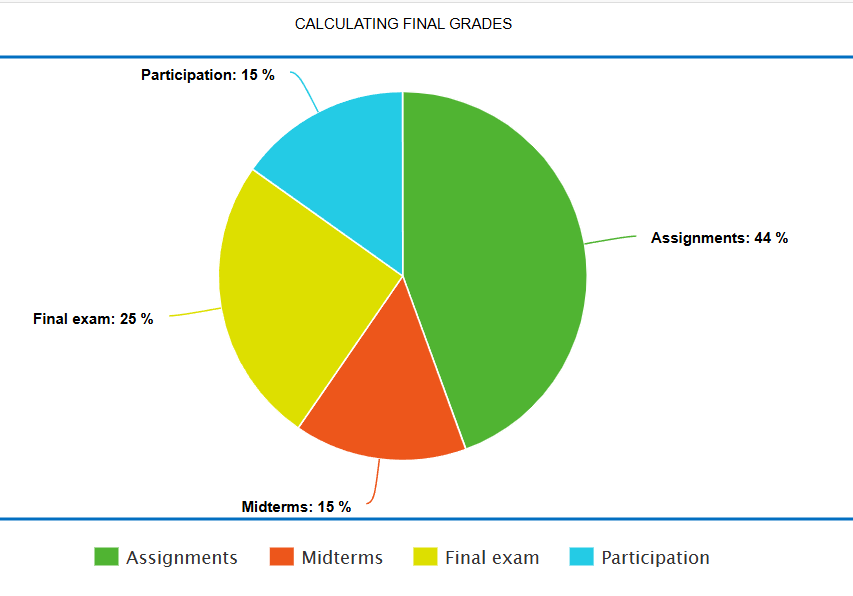
I gave assignments the highest weight because they show a student’s understanding over a longer period of time. I would still include midterms and final exams, but I would not make them worth most of the final grade because one stressful exam may not fully represent what a student knows.
Using these weights, the final grades would be:
- Student A: 77.3%
- Student B: 76.7%
- Student C: 79.8%
- Student D: 68.9%
Student C received the highest final grade, even though they had lower midterm and final exam marks. I do not think Student C should receive a much lower grade because they performed very well on assignments and participated regularly. Their exam grades should still affect the final result, but their assignments show that they understood the material and were able to apply it throughout the semester. The lower exam grades may have been caused by time pressure or difficulty performing in an exam setting.
Overall, this week’s material made me think more about how grades are calculated and whether they always represent a student’s actual understanding. Technology can improve assessment by making submissions, grading, and feedback faster, but the type of assessment is still important. I think using a combination of assignments, projects, participation, and exams creates a more accurate picture of what a student has learned than relying mostly on one or two major exams.