Group Blog links:
Shubin Wang : https://shubinw.opened.ca/
Eric Ding : https://ericdingedci339.opened.ca/
Hasan Sheikh : https://hsedci339.opened.ca/
Introduction
After choosing VR in education as our inquiry topic, this week we are focusing on understanding what VR actually is and how it is already being used as a learning tool. Before evaluating its benefits and limitations, we want to first understand the technology itself and some roles it plays in education. By exploring some existing applications of VR in classrooms, we can then examine its potential impact on the future of education.
What is Virtual Reality (VR)?
VR is a technology that uses computer-generated environments to create immersive experiences that simulate the real world. By wearing a VR headset, users can look around and interact with their environment as if they were actually present in it. Within the field of education, VR can be used to create engaging learning experiences such as virtual field trips, simulate science experiments, and provide hands-on training for skills. This allows students to learn in ways that may not be very accessible in a traditional classroom. For a better dive into what VR is, check out the video below!
How is VR normally being used?
Currently, VR has become increasingly popular for a variety of uses due to its ability to provide more engaging and realistic experiences than traditional media. One of the most common applications of VR is in gaming. Players use VR to immerse themselves in virtual worlds and interact with objects in first person, providing a more realistic gaming experience than other methods. Additionally, VR is also used in entertainment outside of gaming, such as virtual concerts, storytelling and other live events for a more immersive experience. Outside of entertainment purposes, VR has also been used for training in the workplace, especially in areas such as healthcare, aviation, and customer service. For example, the Johnson & Johnson Institute has used VR to train surgeons in complex medical procedures and to manage diagnostic equipment. Along with training, VR is used to create simulations in many fields, such as flight simulation in pilot training and driving simulation for training in the transportation industry. Therefore, since VR can create these more immersive experiences, they have become increasingly adopted to create learning environments that may be difficult or impossible to experience in a traditional environment.
How VR is currently used as a tool for learning
VR is not only used for gaming or entertainment, but it’s also becoming a powerful learning tool. VR can give students the chance to experience places, ideas, and situations that would normally be difficult, expensive, or impossible to access in a regular classroom. VR can take students on virtual field trips to places they may not be able to visit in real life, such as museums, historical sites, or even another country. VR can also help students understand complex ideas in subjects like biology, chemistry, and engineering by making it possible to view and interact with 3D models instead of reading about them in a textbook. For instance, in science, students can explore the human body, examine cells, and observe chemical reactions in the body up close in a more visual and interactive way.
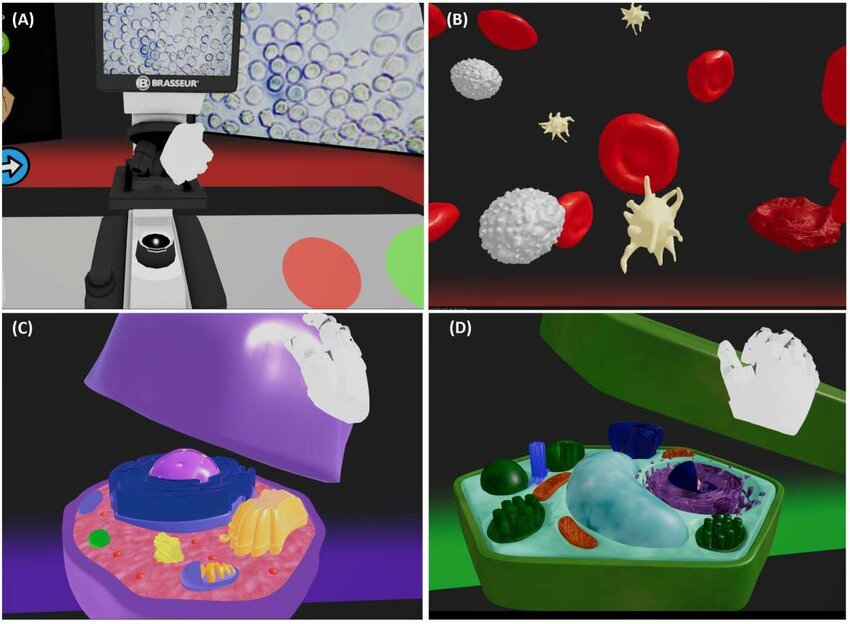
VR is also being used for skill practice and simulations, especially in fields like healthcare, nursing, and engineering. The Johnson & Johnson Institute, for example, uses VR training to help surgeons practice procedures and build skills with repetition in a simulated environment so surgeons can perfect their craft before operating on a patient.
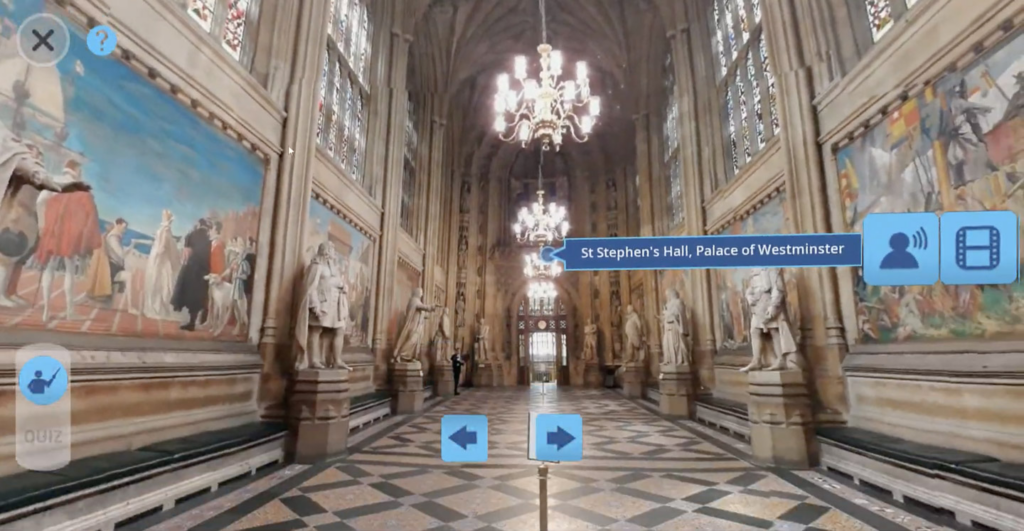
VR can also support history education by allowing students to experience historical places or events in a more immersive way. Overall, these examples show that VR can make learning more active and engaging by helping students move from simply reading or watching to actually exploring and practicing.
The video below gives a useful overview of how VR can support classroom learning by showing examples from science and other educational settings.
Connection to Distributed and Open Learning
VR connects to distributed and open learning because it can give students access to learning experiences from different locations. For example, a student could explore a museum, visit a historical site, or complete a science simulation without needing to be physically there. This supports distributed learning by making education less limited by location and by giving students more interactive ways to learn online. However, VR also has some challenges because headsets and software can be expensive, which may make it harder for some students or schools to access. Because of this, VR has strong potential for open and distributed learning, but access and affordability still need to be considered.
Reflection
This week, we learned that VR is more than just a tool for gaming and entertainment. It is already being used in education to create more immersive, interactive, and accessible learning experiences. Next week, we will look more closely at the benefits of VR in education.
Resources
Whats ZEE. “What is Virtual Reality (VR)? A Simplified Explanation! ” YouTube, https://www.youtube.com/watch?v=pI-4NctNO0M
Johnson & Johnson Institute. “Virtual Reality.” Johnson & Johnson Institute, https://jnjinstitute.com/en-ca/virtual-reality
Johnson & Johnson. “How Johnson & Johnson Uses Virtual Reality for Training | Oculus for Business.” YouTube, https://www.youtube.com/watch?si=Fx8h1ruRWmD9p5-5&v=6E6CVgbWiqk&feature=youtu.be
“10 Best Examples AR & VR in Education.” YouTube. https://www.youtube.com/watch?v=JTJSu5H6eGA
Tech & Learning. “Best Virtual Field Trips.” Tech & Learning, https://www.techlearning.com/news/best-virtual-field-trips
Jobs for the Future. “VR in Education: Addressing Challenges and Unlocking Possibilities.” JFF, https://www.jff.org/blog/vr-in-education-addressing-challenges-and-unlocking-possibilities/
Auganix. “EON Reality Unveils Addition of Virtual Reality World Heritage Sites to Its AR and VR Library.” Auganix, 23 July 2020, https://www.auganix.org/eon-reality-unveils-addition-of-virtual-reality-world-heritage-sites-to-its-ar-and-vr-library/
Matsuda, Yuki, et al. “Visualizing the Unseen: 3D Cell Microscopy Through Virtual Reality.” ResearchGate, 2023, https://www.researchgate.net/figure/This-figure-describes-the-perspective-of-using-the-microscope-as-well-as-the-various_fig2_372621395